 Real Estate Social Content
Luxury real estate marketing ideas: 7 approaches for the discretion-first buyer
Seven approaches for the working $2–5M tier — cinematic video, listing microsite, keepsake print, professional referral loops, and more.

You already know the mainstream real-estate marketing playbook. Post the Reel on Day 0. Blast the just-listed email. Boost the open-house flyer. Retarget everyone who spent more than 30 seconds on the listing page.
Then you get a $3.2M waterfront and the whole playbook starts to feel wrong. The seller doesn't want the neighbours to know the house is on the market. The buyers you're actually chasing are not scrolling your boosted post. The open house they attend is a private one, held on a weekday afternoon, with two couples and a wealth manager.
Luxury marketing is a different playbook, run on inverted assumptions from the mainstream one. Most listicles on this topic miss that because they lean on the $10M+ trophy-home archetype (the Bel Air comp, the Aspen chalet, the Palm Beach beachfront) where every approach is priced for a market of ten buyers globally. Almost no agent actually works there.
What if my listings are $1.5M–$5M, not $20M?
That's the tier this piece is written for. In most US metros, sub-$5M is where the working luxury market lives — enough buyer discretion that mainstream tactics feel loud, enough deal volume that a repeatable process pays off. The approaches below work at $2M and at $12M; the trophy-home add-ons (private-jet events, glossy magazine spreads) don't need to.
Below is the discretion-first playbook. Seven approaches, each one framed against the mainstream default it replaces.
Luxury marketing runs on different economics than mainstream marketing
Before the approaches, the shape of the market they're built for. Four things flip when you move from mainstream to luxury:
- The audience is small. In most US metros, the pool of qualified buyers for a $3M+ home is a few hundred people at any given moment, most of them already known to two or three agents. There is no scale to reach them at.
- The decision cycle is long. Mainstream buyers can go from listing view to offer inside a week. Luxury buyers take months, often years if it's a second home. The marketing job is to stay warm across that cycle, not to convert on the first touch.
- Discretion is a feature of the product. Sellers at this tier often don't want passers-by to know the house is on the market, whether for privacy, tax planning, family reasons, or negotiating position. Broadcast marketing works against the deal, not for it. Buyers, likewise, don't want to be seen scrolling Zillow at 11pm looking for the next house; they want a call from an agent who "just heard about something."
- The deal often closes before the listing goes public. A meaningful share of luxury transactions happen off-market or coming-soon, through broker networks and warm referrals. If the MLS post is your first marketing act, you're too late.
The atelier model is instructive. A couture house doesn't put its collection on a rack for foot traffic; it shows a small, curated set of pieces to a hand-picked client list, by appointment, in a room designed for that showing. The haute couture tradition is built on the same commercial logic your luxury seller lives by: fewer people, better people, first.
Everything below is a variation on that logic — showing less to fewer people, deliberately.
Who you're actually marketing to at $2–5M
The buyer archetype in the trophy-home listicles is the ultra-high-net-worth household — $30M+ net worth, home #4, jet on standby. That reader is real but rare. The tier that dominates your day-to-day is different:
The primary buyer for a $2–5M home is often a successful professional or business owner buying a first or second luxury property, mid-40s to 60s, with the financial capacity but not the lifestyle bandwidth of the ultra-wealthy. They shop with more research and more caution than a trophy buyer. They read listing microsites end-to-end. They talk to their wealth manager before making an offer. They are usually referred, not advertised to.
The secondary buyer is the relocating executive or repatriating expat — same demographic, tighter timeline, higher openness to seeing options fast. This buyer does respond to well-produced video, because they are physically distant from the market.
Both buyers share the trait that matters most for your marketing: they will judge you by the artefacts you produce more than by the volume of them. One well-shot listing microsite outperforms twenty postcards.
What's shifted in luxury marketing this year
Four moves the last twelve months have forced:
- MLS clear-cooperation enforcement now treats one public Reel as public marketing. NAR's Clear Cooperation Policy requires the listing broker to submit a property to the MLS within one business day of any marketing to the public, and "the public" has been reinterpreted to include a single Instagram Reel of a pre-market home on your public feed. Serious pre-market work has moved onto Close Friends, broker forums, and brokerage-native private-exclusive channels as a result.
- Broker-only private networks are bigger than they were. Top Agent Network's membership surged after its January 2025 antitrust settlement with NAR gave it a clean legal footing to circulate off-market listings. Compass Private Exclusives and Coldwell Banker Global Luxury's private-listing streams have grown in parallel. If you haven't logged into your brokerage's internal pre-listing network in the last quarter, it likely has more inventory and more subscribers than it did a year ago.
- Cinematic per-listing video moved down-market. A $5,000-and-up bespoke shoot from a shop like Bespoke Real Estate is still the right call on a trophy listing. What changed in 2026 is that AI-assisted edits calibrated for property work put a genuinely cinematic per-listing video within reach at the sub-$5M tier, without an in-house production team. The economics of the cinematic-video approach below are meaningfully different from what they were even 18 months ago.
- High-net-worth buyers now spend real time on YouTube home tours. Enes Yilmazer's channel alone runs around 15 million views a month, most of it viewers with the means to buy the homes on screen. Your seller has watched more of that footage than they had a year ago. Their reference for "what my listing video should feel like" is now the visual grammar of the YouTube tour, not the MLS walkthrough.
The seven approaches, one by one
Each of the shifts above changes which of these approaches carries the most weight for your next listing. What follows is the operating layer — how to actually run each one.
Cinematic property video
The mainstream real-estate video is a walkthrough — camera on gimbal, agent introduces the home, room-by-room narration, upbeat music bed. It works. It doesn't work at this tier.
The luxury version is closer to a short film. Slow reveals. Long-lens compression. Water, light, curtains moving. The house is a character, not a floor plan. The agent is often absent from the frame entirely. Music is licensed, not loop-library.
The clearest working example is Bespoke Real Estate's video program — a Hamptons brokerage that only lists at $10M+ and treats each listing like a movie shoot, with a dedicated in-house video team producing every film. Their published portfolio is the working reference for what "cinematic" means at this tier.
For a visual reference your seller will recognize, Enes Yilmazer's YouTube channel (4.2M subscribers, mostly trophy-home tours) has set the production standard buyers now expect. You are not shooting to that budget. You are shooting to that visual grammar.
Private-preview reels for a warm list
Reels work in luxury. Public reels do not. Two reasons.
First, the seller often doesn't want the neighbours (or their broker's-office rivals) to know the house is being marketed. A public Reel closes the door on that.
Second, NAR's Clear Cooperation Policy treats any promotion of a listing to the public (including a single Instagram Reel) as marketing that starts the MLS-within-one-business-day clock. If your intent is a discreet pre-market period, one Reel posted to your public feed forfeits it.
The workaround is the same one every serious luxury agent already uses: post the walkthrough where the audience is qualified and the venue is compliant.
- Instagram Close Friends. Curate a list of your top ~150 sphere contacts — past clients, active buyers, referrers, cooperating agents. Post the pre-listing walkthrough as a Close Friends story. It reads as an insider tip, not a broadcast.
- Broker-only forums. Top Agent Network and similar invite-only professional groups let you circulate a coming-soon listing to thousands of vetted top-producing peers in one post. TAN in particular saw a membership surge after its January 2025 antitrust settlement with NAR, as agents looked for compliant venues to share off-market work.
- Brokerage private-exclusive channels. Compass, Coldwell Banker Global Luxury, and most large luxury brokerages run internal pre-listing networks. If yours does, use it before you use anything else.
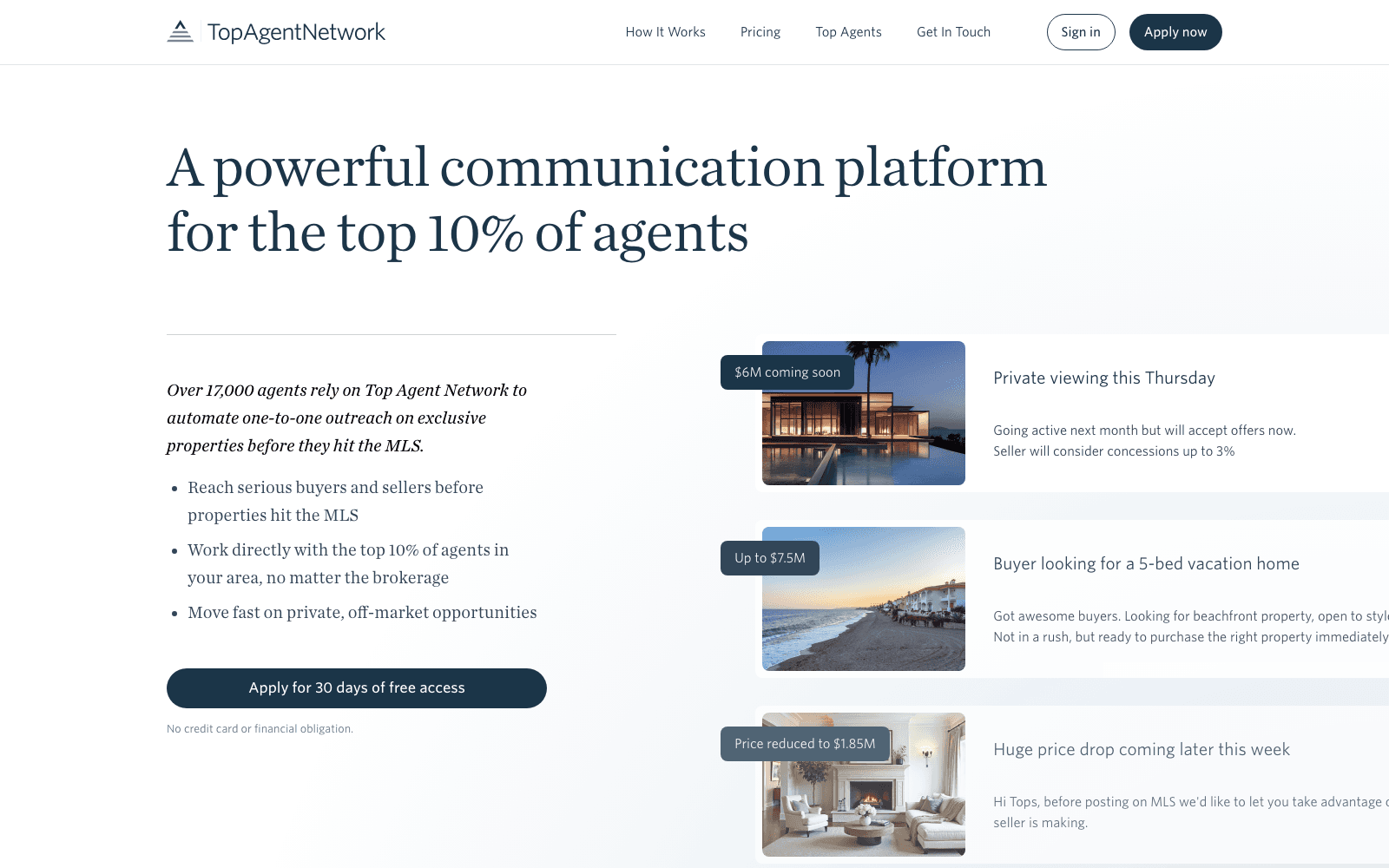
The public feed only comes on after the pre-market window closes and the listing goes live — and even then, the video posted there is usually the polished cinematic edit, not the fast walkthrough shared privately a week earlier.
A per-listing microsite
The MLS detail page is the same shape for every listing in your market. Your $4M oceanfront and the neighbouring split-level both live on identical templates, with the same photo carousel behaviour, the same "similar homes" grid at the bottom pushing the reader to competing listings.
At this tier, that's a marketing loss. The alternative is a single-property website — a bespoke microsite on its own URL, dedicated to one home, with no competing listings on the page.
NCalma Homes' microsite for Waves Marina is a clean working reference: dedicated URL, full-bleed hero video of the property, a top-nav that walks the buyer through Concept, Location, Facilities, Specifications, Design, and a single Request information CTA — no MLS chrome, no competing homes at the bottom of the page.
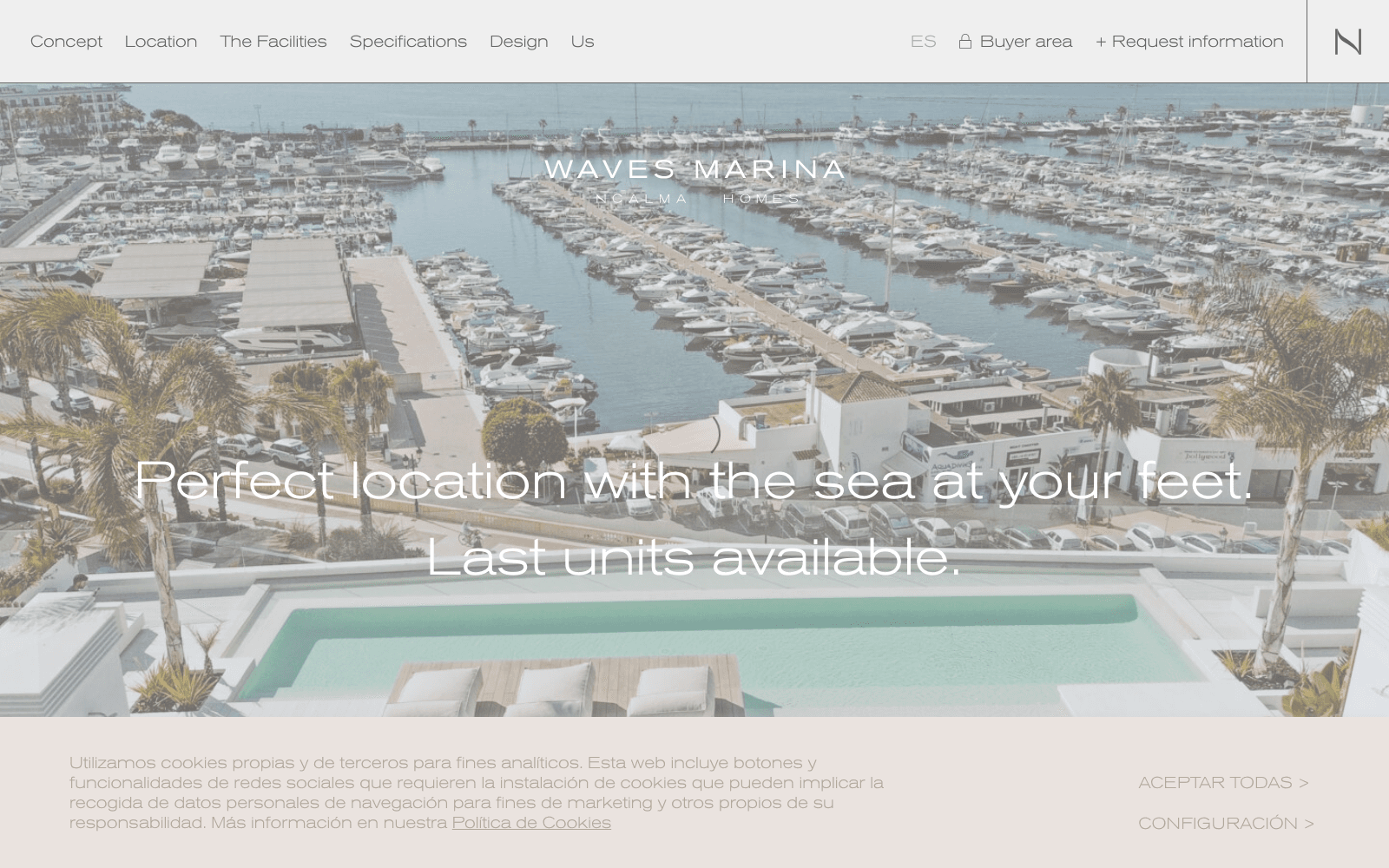
What earns its keep in the build:
- A cinematic hero video at the top — this is where the film from the cinematic-video approach earns its most attention
- An editorial photo gallery — one image per row, generous negative space, no lightbox chrome
- A "story of the house" section — architect, age, notable renovations, provenance details
- Floorplan and site plan as downloadable PDFs, not embedded images
- A single, prominent "Schedule a private showing" form — no email newsletter capture, no chatbot
- Neighbourhood context that reads like a New York Times travel piece, not a bullet list
The microsite has a second use that surprises most agents the first time: it doubles as a seller-presentation asset. Walking a prospective seller through the microsite you built for the last comparable home in their neighbourhood is a stronger listing pitch than any brochure you can print for them.
Long-form keepsake print
Direct mail still works in luxury. The default execution (the glossy postcard every quarter with your listings and headshot) mostly doesn't. It arrives at a house where a housekeeper opens the mail and puts it in the paper bin.
The version that survives is a keepsake, not a postcard. Something the recipient sets down on a console table because they haven't decided whether to keep it. Three formats consistently earn that fate:
- A once-a-year neighbourhood book. Hardback or heavy-stock paperback, 40–60 pages, market data plus long-form photography of homes sold that year. Print run of ~500 copies, hand-delivered to your target streets and past clients. Same recipient list as every quarterly postcard you'd have sent, one artefact instead of four.
- A per-listing property book. For a $3M+ listing, a small run (~100 copies) of a linen-bound listing brochure, delivered to the top comparables' owners, cooperating agents, and known referrers. The book is the tour when the person can't attend the tour.
- The single-piece announcement. For coming-soon or off-market listings, a folded card in heavy stock, hand-addressed, mailed to a shortlist of ~40 known agents and referrers. No headshot, no listings grid, no phone number in bold. Just the address, the price, and a private-showing contact line.
The brand-owned magazines from the global luxury brokerages are the reference for the register. Sotheby's RESIDE magazine and Christie's Luxury Defined are the most visible examples of the format at scale. You are not printing at that scale. You are borrowing the design restraint.
The social feed as portfolio
Ask most agents what their Instagram is for and the answer is "leads." At the luxury tier, that framing produces the wrong feed — heavy on tips, boosted posts, quote cards, calls to action. The feed that actually works reads as a portfolio for the people who might refer you, not a shovel for cold buyers.
Two reels that show the register in practice — listing footage as content, no direct-response prompts, the account itself as evidence for a referrer:
Compare the accounts of the three most-cited luxury agents in industry press:
- Ryan Serhant (NYC, 2.7M followers) — the feed is roughly one part listing footage, one part behind-the-scenes at Serhant Media, one part personal brand. Almost no direct-response prompts. The whole account is evidence for the referrer.
- Aaron Kirman (LA, over $24B in career sales) — feed skews architectural, editorial, minimally captioned. It looks like a design magazine's Instagram, not an agent's.
- The Altman Brothers (Beverly Hills / Bel Air) — feed weighted to listings, family, and behind-the-scenes at the brokerage. The listings are the content; the CTA is implied.
You are unlikely to run a content studio at Serhant scale. You do not need to. What you need is a feed that a wealth manager or an interior designer could scroll through in 60 seconds and think "yes, I can send my client to this person." Aim the feed at that reader, not at the buyer.
The bottleneck for most agents is not what to post but what to post with. If you are working from listing photos on a phone, Dunphy turns them into a Cinematic Tour or Highlight Reel that reads at the register a referrer expects — more on how that works here.
Concierge email alongside your newsletter
The mainstream email default is the monthly newsletter — five listings, one market update, three community photos, unsubscribe link at the bottom. At the luxury tier, the newsletter mostly gets archived unread.
That said, the newsletter is not worthless. It is a top-of-mind tool for the year-round audience of past clients and casual referrers — a light-touch reminder that you are still active in the market. Keep sending one. Keep it short. Keep the design restrained.
The revenue work happens in the second track: named-buyer, sequenced, concierge outreach. Meaning:
- A prospect list that lives in your head or your CRM, not your newsletter tool — 20–80 named individuals you are actively working
- One-to-one emails that reference the specific conversation you last had, the specific neighbourhood they mentioned, the specific criteria their wealth manager gave you
- A cadence measured in weeks and months, not sends per month — three thoughtful touches a year beats twelve generic ones
The two tracks are not in competition. Newsletter for top-of-mind. Concierge for pursuit. Most agents run one and skip the other; the ones who win at this tier run both, and never confuse which list gets which message.
Referral loops with adjacent professionals
The most underinvested channel in luxury is professional adjacency — the ring of attorneys, wealth managers, designers, private schools, boutique lenders, and family offices that already sits next to your buyers. The Institute for Luxury Home Marketing puts these professionals at the centre of its prospecting curriculum, and the reasoning holds up in the field.
The approaches that work here are structural, not transactional. You are not asking your CPA to send you a lead. You are becoming the agent that CPA can safely attach their name to. Three practical shapes:
- Sit on the vendor side of someone else's project. An interior designer redoing a $4M home has a client relationship with the eventual seller. Show up on the vendor list — offer to shoot the finished home for the designer's portfolio, at your cost, in exchange for co-branding on the images. You are now part of the finish-line moment.
- Run a small-format professional lunch, quarterly. Six to eight people around a table — one wealth manager, one estate attorney, one private-school admissions director, one boutique lender, one interior designer, one general contractor, and you. No pitch. Market update, off-record deal talk, coffee. Repeat every three months with mostly the same people. The referral loops build themselves.
- Publish for the professionals, not the buyers. A short quarterly note to those same six professionals — market data, off-market inventory notes, anonymized transaction stories — sent as a personal email, not a mass newsletter. This is what makes you the agent they think of when a client asks.
The Inman Luxury Referral Network and the ILHM's own Certified Luxury Home Marketing Specialist (CLHMS) directory are the two most-used cross-agent referral pools if you want a broader net beyond your local professional list.
What to skip in 2026 if you're not at $10M+
Some of the tactics in every trophy-home article are priced for a tier you don't work in yet. Skip them without guilt:
- Full-page ads in the print luxury magazines — priced in the mid-four to mid-five figures per placement, with buyer-attribution nearly impossible to measure at your listing volume.
- Gala and charity-event sponsorships bought purely as a marketing spend. The ones that pay back are the ones you'd attend anyway.
- Private-jet-tarmac events, yacht-club preview parties, and similar staged experiences. Wonderful if you have a $25M pocket listing and a client already flying in; a poor first move if you don't.
- International brokerage franchise dues bought before you have the international deal flow to feed them.
None of these are wrong at the trophy tier. All of them are the wrong first spend at the working luxury tier.
Marketing yourself as the luxury agent, before you have the listings
The hardest part of moving into luxury is the chicken-and-egg — sellers want an agent who has already sold at their price, and you can't sell at their price without an agent who has already sold at their price. Two practical moves that break the loop:
Sell adjacent to your target for 12–18 months. If your goal tier is $3M, the honest bridge is $1.2M–$1.8M in the same neighbourhoods you want to work. You'll build the local comps knowledge you'll need at the higher tier, plus the buyer-side relationships and the professional-adjacent contacts that the referral-loops approach depends on. Every one of those listings should get the full playbook above (microsite, cinematic video, keepsake print) even when the sale price doesn't quite justify it yet. You're funding the marketing at a loss to build the portfolio that earns the next tier.
Sell the process, not the sales. Your listing presentation should walk the seller through the artefacts you would produce for their home, not the awards you've won. Show the microsite you built for the last home in their neighbourhood. Show the video you produced. Show the professional referral list you'd distribute the coming-soon note to. Sellers at this tier hire process, not history, once the process is credible.
Common questions from agents starting in luxury
Frequently asked questions
How to advertise luxury real estate without looking desperate?
What is the 3-3-3 rule in real estate?
What are the 7 Ps of luxury marketing?
How much should luxury marketing cost per listing?
Do I need a separate website for my luxury brand if my brokerage already has one?
How do I get my first luxury listing to practice on?
Where to start on your next luxury listing
Cinematic Tour is built to run the cinematic-video approach at the sub-$5M tier, where a $5,000 bespoke shoot doesn't clear the ROI bar but a static gallery undersells the home. It produces a 20-second edited walkthrough from your listing photos, with pacing and motion calibrated to the format — the hero video for your per-listing microsite, and the raw material for the Close Friends preview. Above ~$5M, or on the hero video for a trophy listing, a human production team is still the right call.
Ship a cinematic tour for your next luxury listing. Generate a Spotlight, Highlight Reel, and Cinematic Tour from the listing photos in three minutes, then drop the Cinematic Tour on your microsite as the hero video.

Written by
Matthew JohnCo-founder & CEO, Typito AI
Co-founder and CEO at Typito AI. I've been dabbling with video storytelling for 15 years and every day on the journey has been exciting. At Typito we're building Dunphy — the AI video agent for real estate — alongside the broader Typito video stack. Writing here about real-estate marketing, video, and integrity in AI-generated content.